A Field Study in Alienation

There is something in our society that’s hard to put a finger on, but somehow all of us have felt it. It’s a silent epidemic of isolation that can be felt in many aspects of our lives. But because of its intricacies, it’s very easy to mistake it for a personal failing.
You might have felt it after looking at a distant friend’s Instagram stories. Who hasn’t thought to themselves, “Why isn’t it me on that boat in Greece?”
And if we look beyond the superficial, many of us share a dissatisfaction with our working lives that is hard to define. We might enjoy a lot of comfort as a result of our jobs, but do we truly feel connected to the process?
After all, even if our lives are becoming increasingly more connected, we are not the best at cohabiting with the vulnerable internal worlds each of us lives in.
Giving It a Name
However, we have the benefit of information.
The philosopher and infamous historical figure Karl Marx has already put in the work to define and explore it. This might give us some solace, as it helps us understand we are not alone in our dissatisfaction.
But it’s difficult not to get discouraged when thinking that such a complex sociological phenomenon has remained relevant for more than a century following his life.
And it’s necessary to say: he might be a controversial figure in his contribution to the widespread ideology of communism and the atrocities associated with it. However, there is value to be found in the theory itself, and it’s one that might help us better understand many current struggles we face.
And if I say so myself, it has an eloquent name that aptly explains its effects.
Alienation.
Who among us hasn’t felt in some way alien to their own lives, to their own work, or even their social circle?
Not to mention the world of objects around us, that so often gets divorced from its roots and the people making it.
So in this article, we will be looking at the theory of alienation itself, taking a pause from its connection to the author’s communist work.
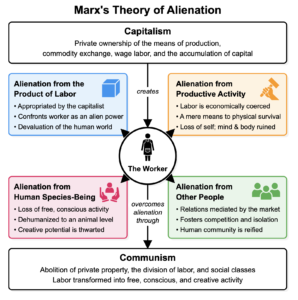
The Stanford Encyclopedia of Philosophy describes alienation broadly as a form of problematic separation or disconnection between ourselves and something with which we ought to have a meaningful relationship. It can appear in our relationship with other people, society, work, the world around us or even ourselves.
As you can see from this diagram, sourced from Wikimedia Commons, there are many aspects which deserve their own study in their own right.
Taking the Question to the Streets
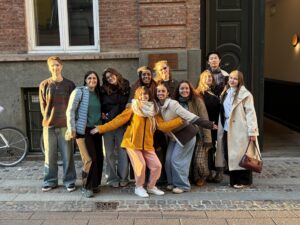
A group of almost 30 students wanted to learn more about it firsthand, talking to people on the streets of Denmark.
And it’s not the easiest topic to bring into the conversation.
While it’s an international, intercultural phenomenon, it’s not always the simplest term to bring into a discussion. Because of its ever-present, albeit elusive character, it remains an undercurrent that doesn’t allow itself to be easily brought out into the public discussion.
This is why our task in this activity was anything but easy, but we did it anyway.
We decided to focus on the work life, the expression of alienation within it and how we navigate around it. We wanted to know what people thought, how they perceived it, and to have an open discussion about something that usually remains in the footnotes of social life, yet somehow touches all of us.
We went out on the streets to get to know the Danish people, and all passers-by who were willing to talk to us about their experiences.
Since we were many people, we had mixed reactions. Even so, it brought us closer to understanding not only why this phenomenon is so widespread, but also effective ways of counteracting it.
Not Quite the Answers We Expected
In fact, most of us left surprised by our casual chats on the street.
Many people didn’t perceive this phenomenon as poignantly as we might have thought. A lot of them said they were quite content with their work-life balance, that they had sufficient time with their family and friends.
Of course, not everyone felt this way, and indeed some people shared that they had to quit their jobs and make a drastic life alteration to account for their lack of personal time and freedom.
But in a positive light, we can look at the feedback we got from people of all ages and intuit that in fact, work can be a healthy, enjoyable part of life.
Finding Happiness Among the Flowers
One life story which stuck with us particularly was that of a charming old man, who took the time to have a friendly chat, even as we were struggling to perfectly formulate our questions in a foreign language.
He had spent his life working in jobs he didn’t feel particularly attached to, focusing instead on the material stability they brought, as many of us do.
However, as time went on, he came to the realisation that time with family, friends, and expressions of passion were life’s true treasures.
He had a deep love for botany, so now he works at a flower shop, and he expressed that he was happier than ever.
This was also aided by the fact that this work allowed him flexible hours, and let’s be honest: it’s hard to be sad when you’re surrounded by nature’s jewels.
Work, Study and the People Around Us
Another couple welcomed our invitation for a chat with a huge smile.
It turns out they were college students, who were balancing their studies with work. And because of the support, love and warm connections they already had in their life, everything they did was coloured with joy.
The young woman talking to us was working as a waitress at weekends, but immensely enjoyed her job, her colleagues and the shared environment. This also brought her more financial independence.
Combined with a supportive family, who was happy to stand behind her through life’s ups and downs, she felt alienation was something that didn’t touch her as deeply as others.
A Conversation on the Street
Another kind soul that took the time to discuss with us was a Romanian lady selling magazines off the side of the pedestrian streets.
Thousands of people were passing her on a daily basis, and yet her smile didn’t seem to leave her face.
We came to talk to her, and of course we wanted to support her work, but since we didn’t have the Danish Kroner, we weren’t able to.
She didn’t take any offence to this, and was happy to tell us more about her life, asking us many questions and enjoying the human connection we were forming.
Even though she didn’t want to go into details of what brought her to Denmark over 20 years ago, she was adamant that the people here are happy, kind and, as she said, good people.
She said that she was enjoying her work and the place she had found for herself in this society, encouraging us to come back to talk to her anytime.
We left this conversation truly touched and rethinking our previous understanding of the subject at hand.
Rethinking Alienation
However, even if we didn’t get the answers we were expecting, somehow this turned into an even more beautiful experience.
Because we saw firsthand that people were indeed happy to take part in larger society through their work, and it sustained them and their social connections.
Of course, this comes with its own context of Denmark’s wealth and functional social programmes.
So maybe while discussing the complex and sometimes discouraging issue of alienation, we ought to take a moment to appreciate the solutions already in place.
How can we imagine a world where work feels meaningful, friends and family are close and everyday life doesn’t feel like a fight for survival?
And is this kind of world already in place?
It seems that, at least for some of the people we met, it is indeed. And we can only hope that one day all of us will enjoy this privilege.
So in this way, our fight for equality might become a simpler one.
We might just need to fight our way to getting to smell the flowers.