European Solidarity Corps Alternatives: How Other Volunteer Programmes Compare
The European Solidarity Corps is one of the best-known routes into supported volunteering for young people in Europe. But it is not the only option, and it will not suit every age group, destination preference, project interest, or time commitment.
If you are researching European Solidarity Corps alternatives, the useful question is not simply “which programme is best?” It is “which type of volunteering structure fits what I want to learn, contribute, spend, and commit to?”
Some alternatives are highly structured and include training, accommodation, local support, and a defined project period. Others prioritise flexibility and destination choice. There are also long-term programmes that combine preparation, volunteering abroad, and reflection rather than treating the experience as a short placement.
This guide compares those models so you can choose on substance rather than name recognition.
Key Takeaways
- European Solidarity Corps volunteering supports eligible young people with core costs, insurance, training, and pocket money.
- Alternatives can differ significantly in age limits, duration, funding, training, destination choice, and support.
- Work-exchange platforms are not direct equivalents to structured volunteer programmes, even when both involve travel and practical work.
- Projects Abroad and IVHQ are useful comparisons for people seeking broad destination choice and shorter formats, while longer programmes suit different goals.
- The Peace Corps is limited to US citizens, so Europeans interested in a similar long-term experience need other routes.
- Volunteer for Change is a 10-month programme combining training in Denmark, six months of community project work abroad, and a final evaluation phase.
Looking for a Long, More Structured Volunteer Experience?
Volunteer for Change combines three months of preparation in Denmark, six months with community development projects abroad, and a final month of evaluation and awareness work. Explore the full programme structure, costs, and application process to see whether it fits your goals.
What Does the European Solidarity Corps Actually Offer?
The European Solidarity Corps (ESC) is an EU initiative for young people who want to take part in solidarity activities at home or abroad. Individual volunteering can last from two weeks to 12 months, while team volunteering is generally shorter.
For standard volunteering activities, participants are usually aged 18 to 30 and must live in an eligible country. Core costs such as travel to and from the project, accommodation and food are covered, alongside insurance, training, support services, and pocket money.
That makes the ESC attractive for people who want a formal framework without financing the full cost of an international placement themselves.
However, it may not fit everyone. You might be outside the age or residency criteria, want to volunteer beyond the available ESC destinations, prefer more extensive preparation, or be looking for a longer learning journey rather than a standalone placement.
ESC vs Volunteer Programme Options Outside the EU Framework
When comparing the ESC vs volunteer programme options run independently, look beyond the destination and compare the model itself.
Ask:
- Who is eligible?
- How long is the commitment?
- Which costs are covered and which are not?
- What preparation or training is included?
- Who leads the project locally?
- How much support is available during the placement?
- Can you choose the destination, or is placement based on project needs?
- Is the main goal service, travel, professional development, personal growth, or a combination?
The ESC is strong on financial accessibility and formal support for eligible participants. Independent programmes may offer broader age ranges, different destinations, more flexible dates, or deeper preparation. The trade-off is that some charge fees or leave more costs to the participant.
There is no single model that is automatically better. The right choice depends on the experience you actually want.
European Solidarity Corps Alternatives Worth Comparing
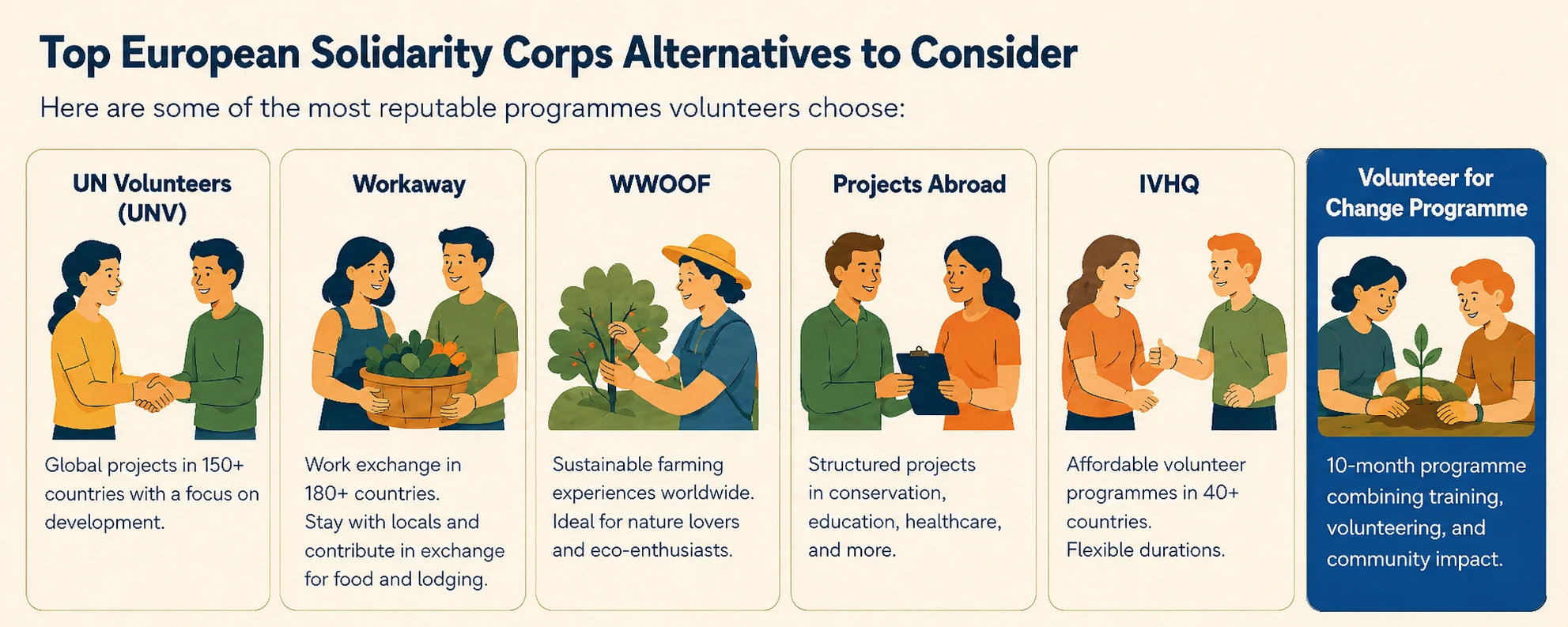
Volunteer for Change Programme at DRH Lindersvold
For people who want a longer, highly structured experience, Volunteer for Change uses a different model from a typical short placement.
The 10-month programme has three stages:
- Three months of volunteer training in Denmark, covering international development, global issues, teamwork, and practical preparation.
- Six months with community development projects abroad, working alongside established project teams.
- One month of evaluation and awareness work in Denmark, reflecting on the project period and communicating what was learned.
The programme charges a fee for the training-centre period. During the six-month project phase, its partner organisation covers specified costs including accommodation, food, flights to the project, travel insurance, visas, and vaccinations. Participants should check the current fee, scholarship options, and exclusions before applying.
This format can suit people who want long-term community involvement, practical learning, an international team environment, and substantial preparation before going abroad.
United Nations Volunteers
United Nations Volunteers (UNV) offers assignments linked to UN entities in areas such as community engagement, development, humanitarian work, communications, and technical support.
UNV updated its volunteer categories in 2026, creating options across a broader range of experience levels. Some assignments are accessible earlier in a career, while specialist and expert roles require more substantial professional experience.
UNV is most relevant if you want a role-based opportunity within the UN system and meet the requirements of a specific assignment. It is less comparable to a cohort-based gap year programme because you apply to individual positions rather than one fixed journey.
Projects Abroad and IVHQ
Projects Abroad and International Volunteer HQ (IVHQ) both offer organised international volunteering across many destinations and project areas. Their models are fee-based and generally emphasise choice: participants can select from multiple locations, causes, and shorter programme lengths.
People searching for Projects Abroad alternatives or IVHQ alternatives are often really comparing flexibility, price, support, and how much structure they want.
If destination choice and timing are your main priorities, providers like these may fit well. If you want one longer programme with an extended preparation phase, months on a community project, and structured reflection afterwards, compare them with a different model such as Volunteer for Change rather than judging only by the list of destinations.
Workaway, HelpX, and WWOOF
Workaway and HelpX connect travellers directly with hosts who offer accommodation, and sometimes meals, in exchange for agreed help. WWOOF focuses specifically on organic farms and sustainable agriculture.
These options offer much more independence than the ESC or a structured programme. That can be a benefit, but it also means you are more responsible for vetting hosts, arranging travel and insurance, understanding visa rules, and deciding whether the exchange is appropriate.
They are better understood as work-exchange or cultural-exchange models than as direct substitutes for formal volunteering programmes.
AIESEC and Local NGOs
AIESEC offers international experiences focused on youth leadership, internships, and volunteering, with conditions varying by country and opportunity.
Direct placements with local NGOs can also be valuable, especially if you already know the cause or region where you want to contribute. Quality varies, so ask how volunteers fit into ongoing work, who supervises them, and how the organisation avoids creating short-term tasks primarily for visitors.
Is There a Peace Corps Alternative for Europeans?
The US Peace Corps is often associated with long-term international service, but standard Peace Corps Volunteer positions require US citizenship. A European citizen who is not also a US citizen therefore cannot apply for the programme.
If that is the type of experience you are looking for, identify which parts of the Peace Corps model actually appeal to you: a substantial time commitment, preparation, living and working abroad, community-based responsibilities, and personal development through service.
Depending on your age and experience, relevant routes can include:
- the European Solidarity Corps;
- selected UN Volunteer assignments;
- structured programmes such as Volunteer for Change.
- reputable long-term NGO placements;
None is a one-to-one European version of the Peace Corps. Comparing the underlying features is more useful than looking for an exact replica.
Funded, Fee-Based, or Work Exchange?
Cost is one of the biggest differences between volunteering models, and the headline fee rarely tells the whole story.
Funded programmes
ESC volunteering covers core participation costs for eligible volunteers. Some UN Volunteer assignments also include financial support under their specific conditions of service.
These routes can reduce financial barriers, but you must meet eligibility requirements and be selected for a suitable opportunity.
Fee-based structured programmes
Providers such as Projects Abroad and IVHQ charge programme fees in exchange for organising placements and support. Volunteer for Change also has a fee, but its structure is different: the fee relates to the training-centre period, while specified costs during the six-month project phase are covered by the partner organisation.
Compare the full cost, including:
- accommodation and meals;
- international and local travel;
- insurance;
- visas and vaccinations;
- training and supervision;
- programme materials;
- emergency support;
- personal expenses.
A lower headline price is not necessarily cheaper overall, and a higher fee is not automatically a sign of better quality.
Work exchanges
Workaway, HelpX, and WWOOF generally involve a platform membership and direct arrangements with individual hosts rather than a full programme fee.
That can make them flexible, but it also places more responsibility on you to assess the host, organise logistics, and understand the support available.
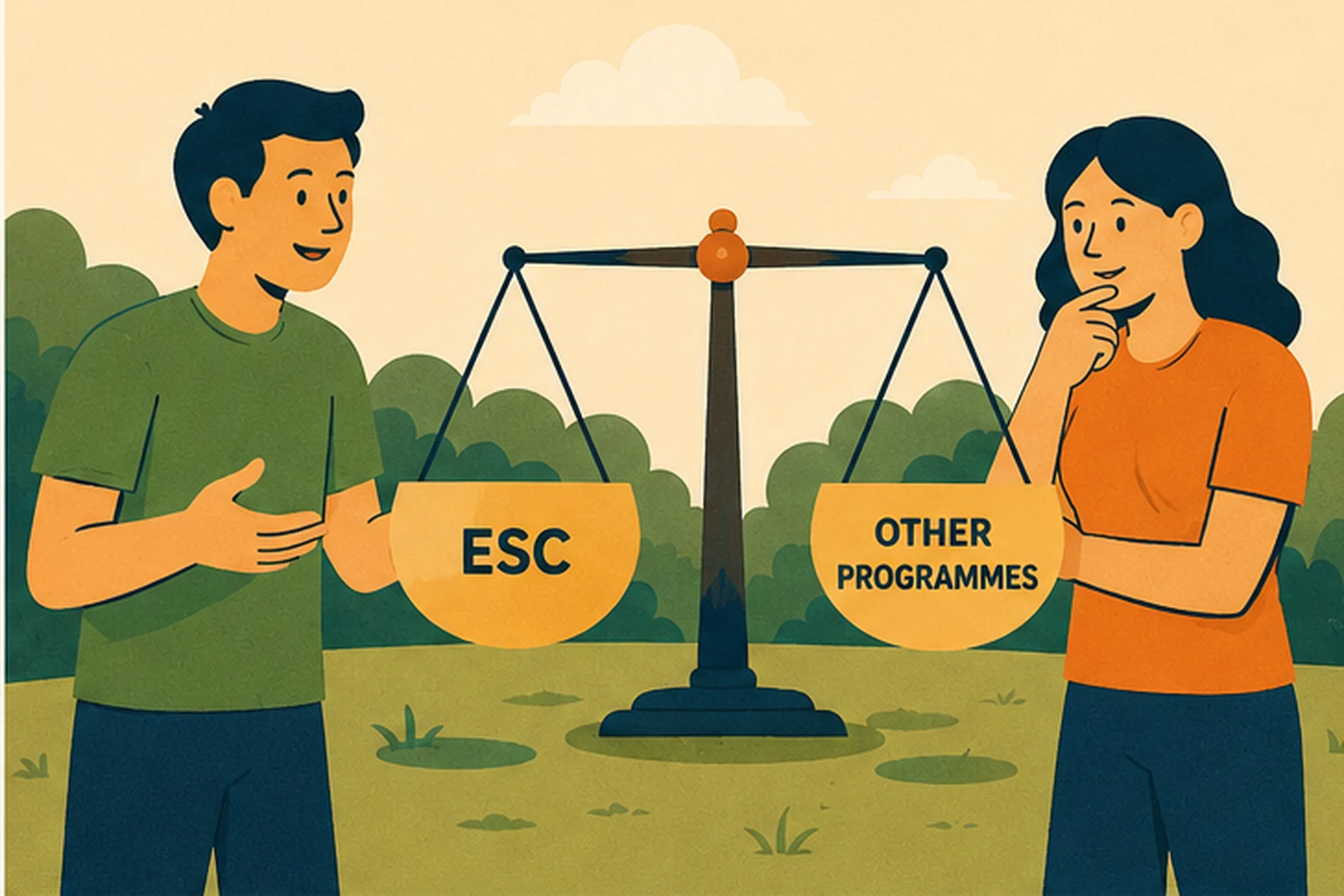
How to Choose Between ESC and Its Alternatives
Start with the experience you want, then compare programmes.
- Decide how long you can commit. A two-week placement and a 10-month programme serve very different goals.
- Calculate the total cost. Include anything excluded from the programme fee or funding package.
- Check eligibility early. Age, residency, citizenship, language, and experience requirements can quickly narrow your options.
- Understand the project role. You should know what you will actually do and why that work is useful.
- Assess training and support. Preparation matters, especially if this is your first time living abroad or working in community development.
- Look at local leadership. Strong programmes fit volunteers into ongoing priorities rather than building activities mainly around visitors.
- Choose the right level of independence. Some people want a cohort and defined structure; others prefer arranging their own host and schedule.
- Ask what happens after the placement. Reflection and evaluation can turn volunteering into a deeper learning experience.
Questions to Ask Before Applying
A reputable organisation should be able to answer practical questions clearly:
- What will I do on a normal day?
- Who decides what the project needs?
- Who supervises volunteers?
- What training is included?
- What happens if I struggle with the placement or living situation?
- Which costs are included and excluded?
- What insurance is provided or required?
- Can I speak to former participants?
- How are safeguarding and safety handled?
- How is the impact of the work evaluated?
These questions are often more revealing than promotional claims.
Which Option Is Best for You?
Choose the ESC if you are eligible, want a supported solidarity project, and value having core costs covered.
Choose a flexible provider or work-exchange platform if destination choice, shorter durations, and control over timing matter most.
Choose a role-based route such as UNV if you want to contribute specific skills and meet the requirements of an available assignment.
Consider a longer structured programme if you want substantial preparation before volunteering, months of project involvement, a team-based learning environment, and time to reflect afterwards.
For that last profile, Volunteer for Change is worth comparing closely. Its 10-month structure is designed as one continuous process: learning, practical community work, and evaluation rather than a short placement added to a trip.
Conclusion
There are many credible European Solidarity Corps alternatives, but they are not interchangeable. Some are funded youth programmes, some are professional assignments, some are fee-based volunteering providers, and others are independent work-exchange platforms.
The best option is the one whose structure matches your goals, resources, and level of commitment. Compare the real project role, training, local partnership, total cost, support, and duration before deciding.
If you want a longer experience that combines training in Europe with sustained community project work abroad, take a closer look at how Volunteer for Change is organised and compare it against the criteria in this guide.
Conclusion
There are many credible European Solidarity Corps alternatives, but they are not interchangeable. Some are funded youth programmes, some are professional assignments, some are fee-based volunteering providers, and others are independent work-exchange platforms.
The best option is the one whose structure matches your goals, resources, and level of commitment. Compare the real project role, training, local partnership, total cost, support, and duration before deciding.
If you want a longer experience that combines training in Europe with sustained community project work abroad, take a closer look at how Volunteer for Change is organised and compare it against the criteria in this guide.
See What a 10-Month Volunteer Programme Looks Like
If short placements are not what you are looking for, explore a programme built around preparation, six months of community project work, and a final evaluation phase. Review Volunteer for Change and decide whether its structure matches the kind of international experience you want.
FAQ
What are the best alternatives to the European Solidarity Corps?
There is no single best alternative. If age or residency is the issue, look at programmes with broader eligibility. If you want more destination choice or a shorter placement, commercial providers or work-exchange platforms may be more suitable. If you want a longer, highly structured experience, compare programmes with substantial training and a multi-month project period.
Is the European Solidarity Corps fully funded?
For ESC volunteering activities, core costs such as travel to and from the project, accommodation, food, insurance, support services, and pocket money are covered within the programme framework. Exact arrangements can vary by opportunity, so check the individual project details before applying.
Can I join an ESC alternative if I am over 30?
Yes. The standard ESC volunteering age range is 18 to 30, but alternatives use different criteria. UN Volunteer opportunities now span a much broader age range, while work-exchange platforms and many independent programmes do not use the same upper age limit.
What is the difference between ESC and Volunteer for Change?
The ESC is an EU-funded framework containing many separate volunteering opportunities. Volunteer for Change is one defined 10-month programme: three months of training in Denmark, six months with community development projects abroad, and one month of evaluation and awareness work. Its funding model, eligibility, destination process, and programme structure are therefore different.
Are Projects Abroad and IVHQ alternatives to the ESC?
They can be alternatives if you are looking for an organised international volunteering experience, but they use a different model. Projects Abroad and IVHQ are fee-based providers with many destinations and project formats, while the ESC is an EU-supported youth programme with specific eligibility and funding rules.
What is a good Peace Corps alternative for Europeans?
Because the Peace Corps requires US citizenship, Europeans need other long-term international service routes. Depending on your age, experience, and goals, options can include the ESC, selected UN Volunteer assignments, reputable NGO placements, or structured long-term programmes such as Volunteer for Change.
Do I need previous volunteering experience?
Not always. Some professional assignments require specific education or experience, while many youth, work-exchange, and training-based programmes focus more on motivation, adaptability, and willingness to learn. Always check the requirements for the individual opportunity.